
Packaging Costs Are Now Influenced by Global Events
The packaging industry is no longer isolated from global geopolitical developments. Events such as the Iran–Israel conflict starting from 28th of February 2026 are actively influencing raw material prices, disrupting supply chains, and reshaping procurement strategies.
For businesses relying on plastic packaging especially HDPE bottles, rigid containers, and closures the impact is immediate and operationally significant. The key concern is no longer whether costs will rise, but whether the industry is entering a long-term phase of elevated pricing.
Why Plastic Packaging Is Under Maximum Pressure
Plastic materials, particularly High-Density Polyethylene (HDPE) and Polypropylene (PP), are experiencing the highest cost volatility. This is primarily because these polymers are directly derived from crude oil.
When oil prices increase, resin costs follow quickly. As a result:
- Suppliers are revising prices more frequently than before
- Procurement cycles have become less predictable
- Manufacturers face challenges in maintaining stable margins
For plastic packaging manufacturers, this volatility directly impacts production planning and pricing commitments.
Beyond Resin: Hidden Cost Drivers in Packaging
While resin price fluctuations are widely tracked, several secondary cost factors are also contributing to overall cost escalation.
These include:
- Internal packaging materials such as polybags
- Corrugated boxes and master cartons
- Stretch wrapping film
- Color additives (masterbatch)
- Logistics, freight, and insurance costs
These elements significantly affect the final cost of products like:
- Jerry Cans used to pack Oil, Chemicals, Agro-chemicals…etc.
- Detergent bottles, caps & closures
- Everyday FMCG / Cosmetics Bottles, Sachets, Pouches
- Pharmaceutical packaging
Because these costs are not always transparently itemized, pricing discussions often become more complex.
The Strait of Hormuz Effect on Supply Chains
A major logistical concern in the current geopolitical climate is disruption in key shipping routes, particularly the Strait of Hormuz.
This has led to:
- Delays in raw material shipments
- Increased freight and insurance charges
- Supply tightness despite stable production levels
This indicates that the industry is facing a logistics-driven constraint rather than a true production shortage.
Demand-Side Pressure Is Increasing
In addition to supply challenges, demand-side pressures are also emerging.
Rising fuel prices and economic uncertainty are causing:
- Reduced consumer spending – as disposable income is decreasing
- Resulting in slower demand in FMCG products especially branded packaged goods
- Lower demand for packaging
This creates a dual challenge for manufacturers’ rising input costs combined with softening demand resulting in margin compression.
Temporary Disruption or Long-Term Shift?
The future of packaging costs depends largely on how long geopolitical instability persists.
Short-term scenario:
- Stabilization in oil prices
- Normalization of logistics
- Correction in polymer prices
Long-term scenario:
- Sustained high energy costs
- Structurally higher polymer prices
- Realignment of global supply chains
Current trends suggest that the industry may face continued pressure in the near to mid-term.
Rising Importance of Recycled Plastics
One of the most significant shifts emerging from this situation is the growing adoption of recycled materials.
As virgin polymer costs rise:
- Recycled HDPE is becoming more cost-effective
- Businesses are rethinking sourcing strategies
- Sustainability goals are aligning with cost efficiency
This shift is creating new opportunities for companies offering recycled plastic packaging solutions.
How Regent Plast Is Responding to Market Volatility
In an uncertain market, supplier reliability and transparency have become critical. Regent Plast is addressing these challenges through a structured and forward-looking approach.
1. Transparent Pricing
A clear link between raw material indices and product pricing ensures better visibility and trust.
2. Data-Driven Cost Adjustments
Pricing revisions are based on actual material trends, allowing more predictable and fair negotiations.
3. Strong Supply Chain Network
A diversified sourcing strategy and robust vendor ecosystem ensure consistent availability across product categories.
4. Focus on Sustainable Materials
Increased use of recycled plastics helps reduce dependency on virgin polymers while supporting sustainability goals.
5. Business Continuity Assurance
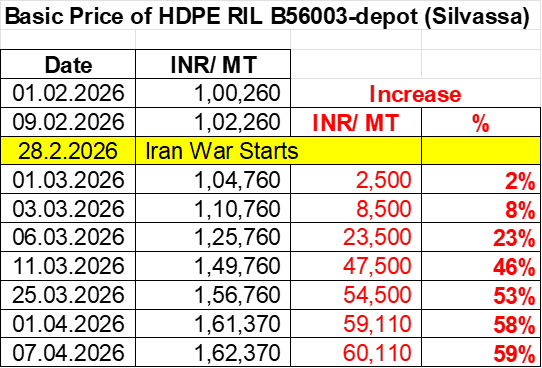
Despite market volatility, the company maintains consistent quality, reliable delivery timelines, and operational stability. In the months of March and April 2026, most customers asked Regent Plast to purchase X Quantity of Polymers at an upper limit of Y per kg from a combination of both primary (from resin suppliers) and secondary market (from traders) purchases, to ensure continuity of supplies and certainty of polymer price. Reason, as shown in the below table, if we were to do spot purchases, we would be outpriced of the market, as all resin producers were releasing polymers in nil/ limited lots followed by increasing in pricing.
Conclusion: Navigating a Geopolitically Driven Market
The packaging industry is entering a phase where geopolitics, energy markets, and supply chains are deeply interconnected.
As a result, procurement strategies are evolving beyond cost considerations to include:
- Pricing transparency
- Supply reliability
- Long-term partnerships
- Increasing adoption of Recycled Plastics.
Businesses that adapt to these changes with the right sourcing strategies and partners will be better positioned to manage uncertainty and maintain competitiveness.
In a packaging world marked by uncertainty and changing raw material costs, consistency sets you apart. Regent Plast delivers precisely that. With transparent pricing linked to real-time material trends, a diversified supply chain, and a growing focus on recycled plastics, we help businesses stay ahead of volatility without compromising on quality or timelines.
From HDPE bottles and containers to fully integrated packaging solutions, Regent Plast ensures your operations remain predictable, efficient, and resilient even when the market isn’t.
Choose Regent Plast for reliability in uncertain times.