
The global manufacturing landscape is undergoing a seismic shift. As industries grapple with climate change and mounting plastic waste, the focus has shifted from “business as usual” to a circular economy. High-Density Polyethylene (HDPE) has long been a preferred material due to its durability and versatility, but the real story lies in the technical innovations transforming how these bottles are made.
From “Value Engineering” to mono-material assemblies, here is how modern manufacturing techniques are helping brands meet and exceed—their sustainability goals.
1. Design for Recycling: The Power of Mono-material Assemblies
One of the greatest hurdles in the recycling process is the “multi-material” trap. Traditionally, an HDPE bottle might be paired with a cap made from a different polymer (like Polypropylene). During recycling, these different materials must be separated, which increases costs and energy consumption.
A major innovation currently gaining traction is Mono-material Assemblies. By matching HDPE bottles with HDPE caps and closures, manufacturers create a single-material package.
- The Benefit: The entire unit can be tossed into a single recycling stream and processed without complex sorting.
- Industry Example: Regent Plast has pioneered this approach, offering a comprehensive range of HDPE bottles and matching caps for sectors ranging from automotive lubricants to agro-chemicals and FMCG. This “design for recycling” strategy ensures that the packaging doesn’t just end up in a landfill but becomes raw material for the next generation of products.
2. Lightweighting: Value Engineering for a Lower Footprint
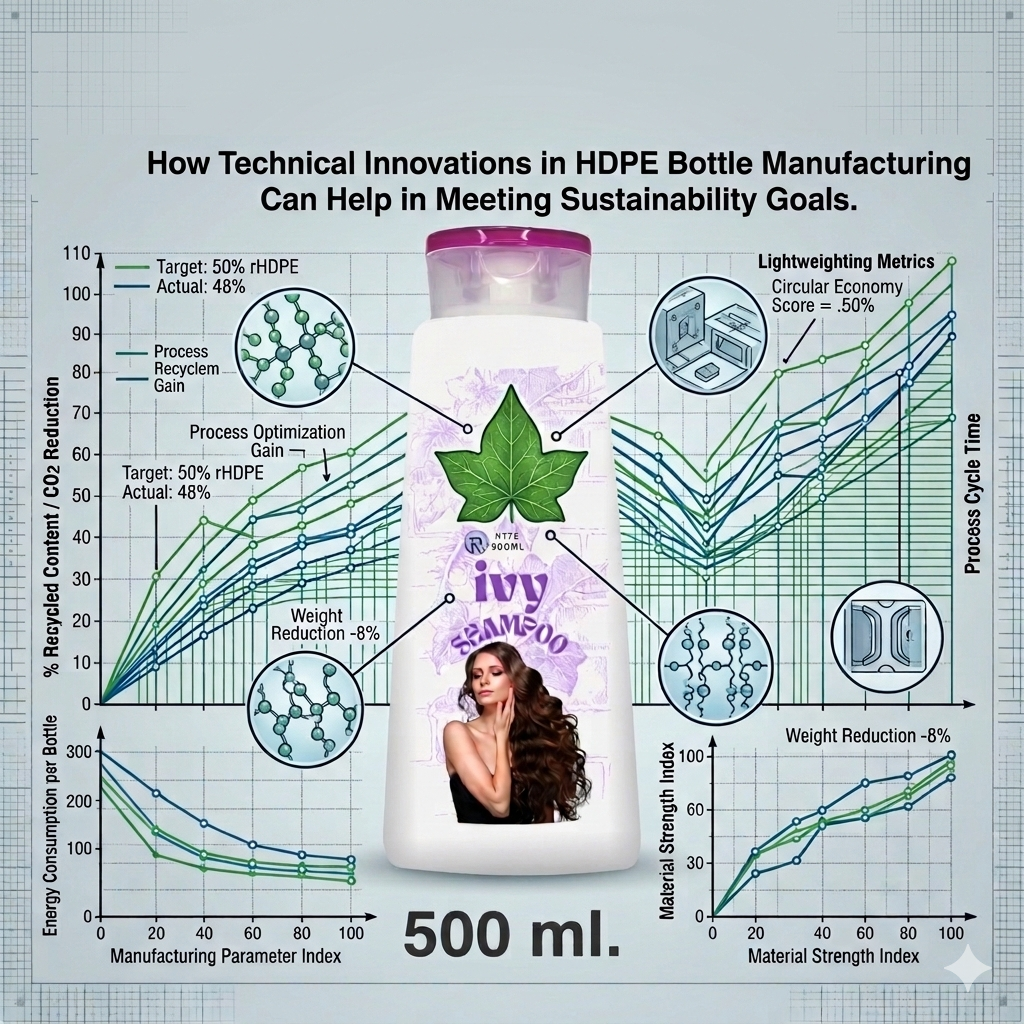
Sustainability is often a game of inches—or in this case, grams. Lightweighting is the process of using advanced “value engineering” to reduce the amount of plastic used in a bottle without compromising its structural integrity.
Technical innovations in mold design and wall-thickness distribution have allowed manufacturers to achieve up to 15% weight reduction in standard bottle designs.
- Carbon Footprint: Lighter bottles mean more units can be transported per truckload, significantly lowering transportation costs and fuel-related CO2 emissions.
- Economic Drivers: Beyond environmental ethics, Extended Producer Responsibility (EPR) fees are a massive driver. Since EPR fees are often calculated based on the tonnage of plastic put into the market, lightweighting provides a direct financial incentive for brands to reduce their plastic consumption.
Link for Case Study of 1 Ltr HDPE Lubricant Bottles
3. Advanced UV & Barrier Protection: Protecting the Product to Prevent Waste
Sustainability isn’t just about the bottle; it’s about protecting what’s inside. In the pharmaceutical and agro-chemical sectors, product spoilage leads to massive resource waste.
Innovations in advanced HDPE formulations now provide enhanced UV-shielding and chemical resistance. This is particularly critical for sensitive liquid formulations that might degrade when exposed to light or oxygen.
- Precision Manufacturing: Meeting these standards requires high-tech infrastructure. For instance, manufacturing for the pharmaceutical sector often takes place in Class 100,000 clean rooms.
- Global Standards: For brands looking to enter regulated markets like the US, technical compliance is key. Regent Plast’s DMF (Drug Master File) certification is a prime example of how technical excellence and regulatory compliance work together to ensure packaging is safe, effective, and sustainably produced.
4. Closing the Loop
The future of HDPE manufacturing is no longer just about “making a container.” It is about engineering a solution that considers the entire lifecycle of the product. By focusing on mono-materials to simplify recycling, lightweighting to reduce carbon emissions, and advanced barriers to ensure product longevity, technical innovation is proving that plastic manufacturing can be a partner in environmental stewardship.
As EPR regulations tighten and consumer demand for “green” packaging rises, these technical advancements are no longer optional—they are the blueprint for the future of the industry.
Is your packaging strategy ready for the circular economy? Explore how technical innovations can transform your product’s footprint at Regent Plast.